Monday, October 25, 2010

Global Handwashing Day

October 15 is Global Handwashing Day.  But you already knew that.  (Right?)  What you do know, I'm sure, is that thorough handwashing does a lot to reduce incidence of various diarrheal and respiratory illnesses.  Remember the number 1 thing we were told during the H1N1 panic last fall?  Wash your hands!  It really is that important.

So Global Handwashing Day...  We live about a 20 minute bike ride from the town of Bounj, where a couple other NGO's are based.  The WaSH (water, sanitation, & hygiene) coordinator from Relief International (RI) organized a Handwashing Day celebration for the region and enlisted help from representatives of other NGO's in the area.  Stephen and I were both representatives for the SIM Sudan Water Project, along with 2 of the Sudanese staff.  

RI invited 5 local schools to participate, so the day started with the schools marching across the football pitch (soccer field) where the day's activities were held.  There were introductory statements, and then each school presented a song they had prepared - mostly having to do with handwashing and hygiene.  After remarks various NGO representatives, the SIM Water Project team facilitated a handwashing & hygiene quiz.  Each school provided 3 volunteers for their team, and each with an NGO "team leader."  We asked 5 multiple choice questions, and had the teams give their team leader the card (A, B or C) representing their choice.  Most of the schools did quite well, and we ended up with a 2 way tie for first place, both of which answered all the questions correctly. 

Students gathered for the event
 
Introductory remarks - use water and soap together for your hands!
Bankuman Primary School singing their song.  Their shirts, from Oxfam, say "Water for life, Hygiene for health"
Quiz time!  You can see the groups of students behind us.
The schools then participated in various athletic competitions - races of different kinds, followed by a handwashing demonstration.  The steps to washing your hands are as follows:
1. Put some water on your hands
2. Get the soap
3. Rub your hands together for 15 seconds (don't skimp!)
4. Rinse your hands thoroughly
5. Let your hands dry

Volunteers were asked for from each school to have a handwashing competition.  Several of the students tried to make it a race, but the two girl volunteers took their time to very carefully and thoroughly wash their hands, so they both won first prize for the contest. 
 
Volunteers for the handwashing competition
 The students then were sent to a nearby school for a meal, during which there was supposed to be a football match (soccer game) of an NGO team vs. a local Mabaan team.  However, as we were sitting by the field waiting for a ball to come (I was not playing - it was just men, and they were being way too serious about it for anyone of my very low soccer skills to participate!), we watched as a very dark, black cloud rolled straight for us.  As the wind picked up, we decided it would be a good time to head over to RI to wait and see what the weather held.  The rain began before we even reached the road, and we were all soaked through (at least on the side the wind was blowing from) by the time we got to RI - which was just around the corner!  So the football match was canceled, and we ended the day by eating our dinner in an office while the rain pummeled the tin roof above us.  Fortunately, RI had a vehicle available to give us a ride home so we didn't have to bike through the mud, pouring rain, and frequent (close!) lightening.

All in all, it was a fun day.  The students seemed to greatly enjoy themselves, and hopefully learn a little too.  And remember...  Wash your hands!

Thursday, October 14, 2010

Biosand Filters

One thing the water project has begun working on recently is the construction of some biosand filters. A biosand filter is a simple, small scale filter for cleaning water. There are a number of ways to make the filters, but we are making them using old aviation fuel drums. AIM AIR, the missionary flight service that brings the missionaries in and out of Doro leaves a stock of drums full of jet fuel by our airstrip, so that the planes can refuel when they land here. The empty drums get piled up in a corner of our compound, and we can purchase them from AIM AIR for a small fee. They are ideal for making the sand filters.

To construct a sand filter, we put a small layer of gravel at the bottom of the filter, and a thick layer of sand on top of the gravel. A flexible hose is placed inside the gravel layer and fed to a tap on the outside of the barrel. The sand and gravel has to be cleaned thoroughly before placing it inside the drum. To use the completed filter, you simply fill the drum with water. The water percolates down through the sand and becomes clean. The way the filter really works is that over time a layer of bacteria forms on top of the sand. This layer of good bacteria actually works to purify the water, as it eats the harmful bacteria in the water as it filters down through the sand. These filters have shown to be very effective in cleaning water. One filter is sufficient to provide clean water for several families in a community.

So far we have constructed one filter which we have located down near the Doro health clinic. Our hope is to construct some more and place them in villages that have access to a source of water, but not a clean source. It could be a dirty borehole or river water. They can then take the water that they have access to and put it in the filter to clean it and make it good to drink.

This is just one of several ways that we are trying to help people in the villages have access to clean water. It is such a neat experience to not only learn about different ways of providing clean water (such as the construction of the filters), but also to be able to help the people with such an important need. Stay tuned for more updates on other ways we are seeking to provide clean water. For now I will leave you with some pictures of the process of making a biosand filter.

Here are the barrels that we are turning into sand filters.
Abel starts getting a barrel ready.
We cut out the top of the barrel and now John is filing the sharp edges.
This is what happens after a hard day's work!
Joseph is preparing the hose to go into the barrel. He is drilling holes in the hose so the water can pass into it.
Abel washing the sand.
Putting the sand into the barrel. Notice the tap is already attached.
Joseph and I with the finished sand filter.


Thursday, September 30, 2010

How to start a fire, in 1 simple step

Here in Doro, we use aviation fuel to start our cooking fires. 

A few years back, there was a plane crash on the runway.  It had rained recently and the south end of the airstrip was still a little soft.  The plane was not quite off the ground when the wheels hit the soft ground, slowing it down enough that the Caravan was unable to clear the trees.  Everyone was injured, but the only fatality was the airplane itself. 

Later on, when the wreck was being cleared away, Sandy (who had been a passenger) asked about the fuel from the plane, which could not be re-used as aviation fuel.  An agreement was worked out, and the fuel was syphoned out of the plane and back into fuel drums.  Since then, the fuel has been used by folks on the SIM compound to start cooking fires.

I don't know how many drums there were to start with, but we are now down to less than 1/2 a drum of fuel, which has caused people to start asking what we are going to do about starting our fires when it runs out. 

We at the water project have found a (short-term) solution - keep using aviation fuel!  You see, AIM-AIR brings in full drums every now and then so that they can refuel when they land on our airstrip.  The empty barrels get rolled over to the compound to sit around until another use is found for them. 

We are using them as structures in which to make biosand filters.  (Stephen will give you more on that later.)  To make the filters, we have to first cut away a part of the lid and clean them thoroughly.  I called them empty barrels, but that is not entirely true - they all contain just a little bit of fuel, which we can dump out and pour into our little plastic bottles to keep lighting fires with. 

Most of the drums contain very little, maybe 150 mL or so.  Certainly no more than 300.  Others, however, contain a few bottles worth.  Yesterday, when we were emptying the drums, you could hear distinct sloshing in 3 of them.  1 still has a quasi-reasonable amount (less than 1/4 full still) which we will likely return to the compound for everyone's use.  The other two clearly contained some mixture of water and fuel, as there were two distinct layers of liquid when we emptied them into a basin.  We were all pretty sure that the fuel would float on top of the water, so we started carefully pouring that into the bottles, but then became very unsure of ourselves, as no-one actually knew the density of aviation fuel. 

That was time, of course, for a make-shift science experiment.  (Hooray science!)  We poured some water into an empty bottle, then poured a small amount of the top layer from the basin in.  Sure enough, we soon had a small layer floating on our known water in the bottle.  Had it been water, it would have mixed and we would not have seen any separation.  But it showed us that the small amount we poured in was of a lighter density than water, therefore a different substance, therefore the aviation fuel, and therefore the top layer in the basin was, as suspected, the fuel.  Hooray science again!

And now we have a few hundred more milliliters of aviation fuel to start our cooking fires with.  That's just what we do here in Doro.

Friday, September 24, 2010

Tales from the road (or something)

We're in Nairobi now, getting ready to head up to Lokichogio on Sunday and then on to Sudan Monday.  The past two weeks have been our mid-term R&R, and they've been pretty full with a little vacationing and Nairobi business, including grocery shopping for the next couple months!

We started off by heading down to Tanzania to visit James, my (Ginny's) brother, for a couple days.  We've been trying to plan this for a while, but since the flights to/from Sudan are chartered they are ever-changing.  Our plan was to leave Sudan on 10 September, and we were supposed to ride on the DC-3 from Lokichogio to Nairobi.  The DC-3, however, was delayed as their first trip of the day was to transport a group of students - who showed up 3 hours late for the flight.  Consequently, we had an overnight in Loki rather than continuing all the way to Nairobi.  This changed our plans, as we were going to take an all day bus from Nairobi to Dar es Salaam leaving at 6 AM on the 11th.  The next idea was to take a bus to Arusha on the afternoon of the 11th (we arrived Nairobi around 9:30) and continue to Dar first thing on the 12th, but then Stephen found some reasonably priced flights directly to Zanzibar on the morning of the 12th.  Much more restful of an option!

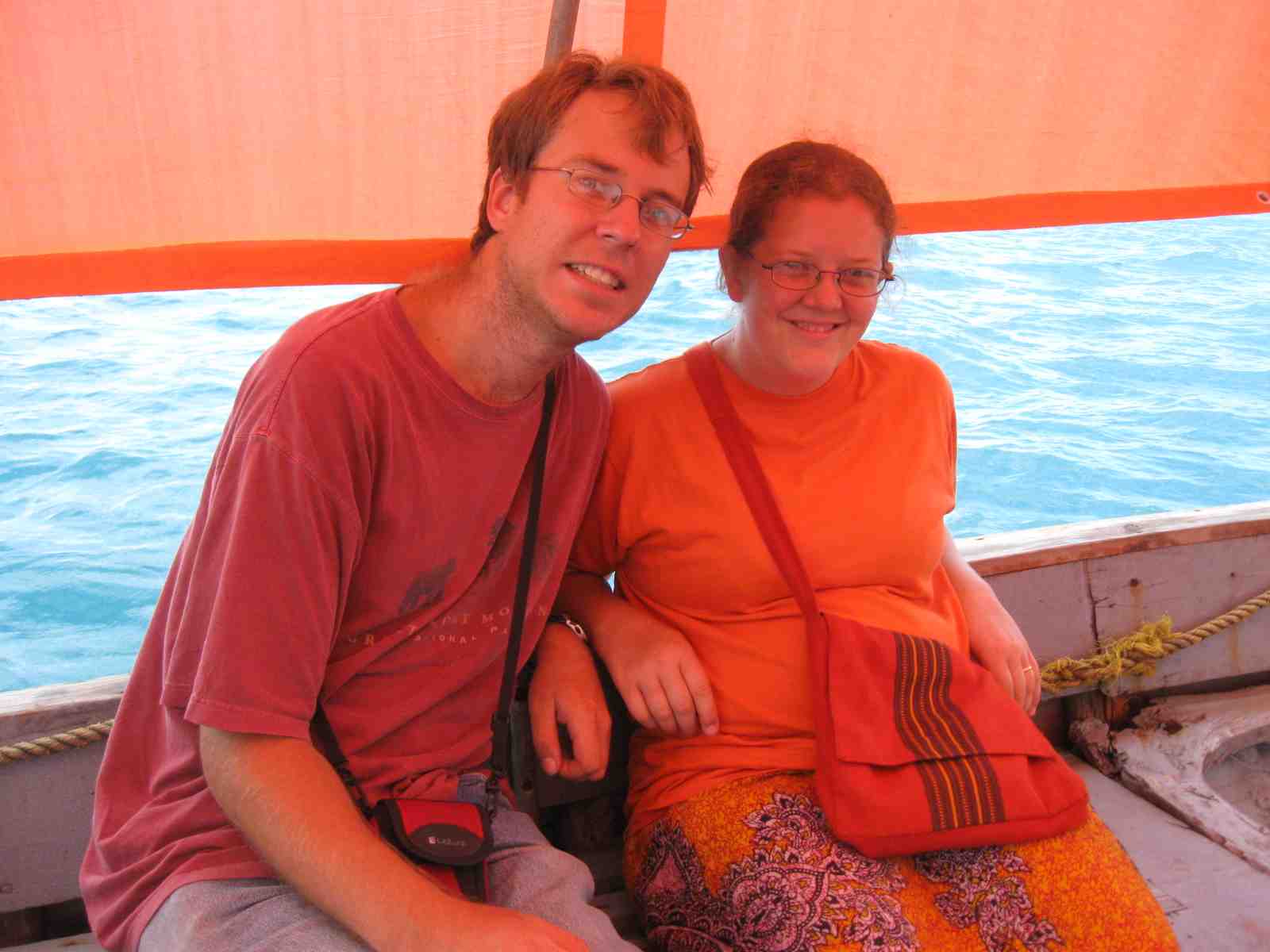
We arrived in Zanzibar around noon on the 12th - the first time to Tanzania for both of us.  (I have, by the way, quadrupled the number of African countries I've been to since we arrived in June.  Yup, from 1 to 4.  Not bad!)  We made our way to the hotel in Stone Town and wandered around a bit before James and his colleagues arrived.  It was a very relaxing couple of days, including snorkeling in the Indian Ocean, wandering around Stone Town, and eating some delicious Swahili food.  We then took the ferry across to Dar es Salaam and the next day took the bus to Nairobi.  We boarded the bus at 5 AM in Dar, and got off at 11:30 PM in Nairobi after a very bumpy ride with seats in the back row.  Needless to say, we were pretty tired!

Since then, we've been taking care of business around Nairobi - settling accounts, doing shopping for the water project, bike project, other SIM Sudan folks, and our own groceries.  We've also had a chance to enjoy some treats we don't often get in Doro, such as the vast quantities of delicious fresh fruits and vegetables, a little ice cream, fresh fruit, liquid milk, movies in a theatre, and restaurants.  The past couple days were spent relaxing in Kijabe, where I went to boarding school for 7 years, and catching up with some folks.

This weekend we're heading back to Sudan - catch you on the flip side!

We had a potluck the night before the flight as one of the team was leaving.  We eat very well in Doro, as evidenced by the FOUR deserts.  What you can't see in this picture was all the delicious potluck dinner food - including doro wot!
On the Doro-Kurmuk-Yabus-Air drop of a solar battery for a satellite phone in the middle of nowhere-Lokichogio flight

Arriving in Lokichogio - this place seemed huge and fancy after a couple months in the bush

View of Kilimanjaro on our flight to Zanzibar!


Landing in Zanzibar

On the boat to go snorkeling

James found a starfish, but put it back before it became too angry.

In 1919, they brought 4 tortoises from the Seychelles to this little island off of Zanzibar.  Now they have a lot more, and they're really big and old - the 2nd largest species of tortoises so we're told.  One of the original 4 is still there.  

Wandering in Stone Town


We had just eaten some delicious Swahili food, and then took about a MILLION pictures in this doorway.

We toured the Anglican church in Stone Town, which is built where the slave market used to be, and the high altar is positioned where the whipping post was.

On the ferry from Zanzibar to Dar es Salaam

Wednesday, September 8, 2010

Clean Water & Sanitation


One of my (Ginny's) big projects during our time here is to see how the water project can assist Mabaan women.  I've developed a set of questions to determine three things: 1) Felt needs  2) Water Usage and 3) Comprehension of water and sanitation.  The idea is to go into a community, interview 3 or 4 women, and then do a follow-up session.  So far, I've done a test a run with the local Doro church women.  I had two interviews, with two ladies answering the questions in one of them, and today had a follow-up session.

We invited all of the Doro church ladies to come at 2 PM for a discussion/teaching/outreach about water and sanitation.  7 ladies showed up, which was about ideal for what I had planned.

First, we had a great time using some of Living Water's health teaching materials.  They have a set of line drawings showing various sanitation-related practices, some of which are good and some of which are not so good.  Each of the ladies got a handful of pictures and took turns describing what was happening in one and then determining as a group if it was a good or a bad practice.  There was some quite lively discussion, but my Mabaan is far to limited to understand all but the occasional word - I picked up on "pwatchin" - good, "yeya" (or yaye?) - bad, and "pieg" - water quite a bit!

Handing out pictures
Katarina explains her picture
Now it's Elizabeth's turn (children, of course, are all around - especially when you're with the women!)
  
Second, I had some photos to show of some water testing I did to try and explain about keeping the containers for water clean.  The ladies seem to at least have a concept of bacteria, so I did my best to explain how we can test for it.  As I said this afternoon, we can put the water on special paper, add food for the bacteria, and put it in a warm place.  If the bacteria are there, they will eat the food and grow until we can see them.  They will look like spots on the special paper.  I didn't find it necessary to go into the more scientifically accurate details, such as there being all sorts of kinds of bacteria everywhere, they're not all bad for you, and the test looks for thermotolerant fecal coliform bacteria, and that the bacteria don't actually grow, they multiply so that what began as one or a few bacteria becomes a very large colony.  But I digress..  I first showed a picture of the test from the local borehole.  The water there is very nice, and there were 0 cfu's (colony forming units, counted as blobby bits on the filter paper after incubation) in 100 mL.  Then, I showed a picture of the test from one of the barrels we store water in on the SIM compound.  It had over 200 cfu's - not to be drunk without filtration, please!  I also showed three treatment photos.  In the first, I had heated water to nearly boiling, and it went down to 2 cfu's per 100 mL.  Much better, but still doesn't meet the EPA drinking water standard of 0.  (Not that the EPA really has jurisdiction in Southern Sudan...)  Five minutes of boiling resulted in 0 cfu's/100 mL, and chlorinating the water also resulted in 0 cfu's/100 mL.  I demonstrated the use of chlorine, as we were giving each lady attending one bottle.  We are able to make chlorine in the water project "lab" by doing electrolysis on water saturated with salt. 
Demonstrating proper use of chlorine
John Kiya, who was translating, explains that the chlorine should be kept out of reach of children.
Tabitha looks at the photos of water testing results

The next section was a short Bible study, being that we are a Christian group.  I read the passage on Jesus meeting the Samaritan woman at the well in John 4:1-26 in Mabaan (!) and expounded a little bit on the barriers Jesus broke by talking to her, and the great gift of living water that he offered her.  While preparing, I initially wanted to use a different passage, as everyone doing water work with a Christian organisation uses this passage, so it seemed a little cliche to me.  But then I read through the passage, and there were a lot of really good things in there so I stuck with it.  Read through it again and think about presenting it to a group of undereducated (but very bright!) women who work hard all day but are undervalued.  Good stuff!  Just yesterday, another SIM missionary - Debbie - began a literacy class for this same group of women.  Very exciting!  They still won't be able to read the Old Testament in Mabaan at the end of it, but neither can the most literate of men since the translation has not been completed.  I hear they have Genesis!
Reading in Mabaan!  Tabitha and Katarina may just be straining to pick up the words in my khawaja accent, but they seem to be listening...
At the end, we gave each of the ladies a bottle of chlorine and a bright pink bar of soap, and then had tea.  Stephen left before tea to prepare for tonight's Men's Bible Study, so I don't have any pictures of it, him being the event photographer and all.
Handing out the bright pink soap!

It was a great afternoon, and a lot of fun.  I enjoyed watching the women in their animated discussions of the pictures, and had some good reactions while reading 26 verses in a language still not entirely familiar to me!  My pronunciation is apparently decent, but I don't know half of the words coming out of my mouth. :D

Living in Sudan has been a great adventure, and doing this work with the women has been especially enjoyable and rewarding.

Sunday, August 29, 2010

Bikes and other news

Here in our corner of southern Sudan transportation by bicycle is quite popular. Hardly anybody has a car, and the roads are dirt and in quite poor condition, especially during rainy season. Thus, in order to get between villages people normally either go by foot or by bicycle. Knowing that the use of bikes is very handy out here, Justin, the water project manager started a bike hire scheme a few months ago. Some generous friends of his back in the UK donated some money to get the scheme started, and with the money he purchased four nice mountain bikes in Nairobi as well as a supply of parts for repairing and maintaining bikes. These bikes are now stored in the water project office building, and anyone in the community can use them for a small fee of 2 Sudanese Pounds per day (less than a dollar in US currency). Over the past few weeks the scheme has really been taking off. We’ve had well over fifty hires in the last month, and we typically get several people over the course of a day coming for a bike. The bikes are good sturdy bikes, so they work well on the rough roads in this region. It has turned out to be a good way to help people in the community, as well as bring in a small amount of money so that the scheme can support itself to some degree. Managing the scheme has been one of my (Stephen’s) main jobs here, but one of our Sudanese workers is also heavily involved in keeping it running.

In other news, life in Sudan continues to go very well. Work with the water project is steadily progressing, and we are continuing to learn a lot. Many of the local men are working in their fields pretty much every day, and some crops are just coming into harvest. The corn is ripe, and it seems that every time we go to visit a village these days we receive a gift of many ears of corn. It is really tasty, especially when roasted, which is the most popular way of eating it around here. Will leave you with a few pictures of the bike hire and other happenings!

Bike hire!  On the left is Abel, who works for the water project.
This cat loves popcorn.  For real.
We had a meal on the compound for a group of (adult) students, and pretty much everyone helped prepare it.
It's rainy season! 
On the road to Nalgan, where we went for church last Sunday.
The church at Nalgan.
Lots of birds!  This picture is for my (Ginny's) dad and Uncle Bob.


Wednesday, July 28, 2010

Of many new things

We've now been in Doro for close to 3 weeks, and have (shamefully) not put up a second blog post in that time.  We're very much enjoying life here, and have gotten settled in well.  Slowly by slowly, we're learning how much really needs to be put out of reach of the pesky thieving dogs (including laundry soap and french presses, apparently!), but the new fence has curtailed their activity.  Needless to say, everyone is exceedingly grateful for the new fence.  

Since herds of goats no longer wander into the compound, we took time this past weekend to set up and plant our garden!  We're now eagerly awaiting the first signs of the coming okra, eggplant, tepary beans, cow peas, pumpkins, cilantro and tomatoes.  Especially the okra.  And cilantro.  
Planting the garden!

During our orientation to the water project, I (Ginny) learned how to use the water testing kit we have, as testing will be one of my responsibilities.  Included in the kit is the ability to test for fecal coliform bacteria, complete with a mini incubator.  The EPA drinking water standard is that there should be none.  Among the water samples we tested were the barrel from which we get our water, and from our Katadyn  ceramic filter, which we use to purify our drinking water.  There were a number of coliform forming units in the source water, but in 100 mL, our filtered drinking water showed none.  We like our filter.  (Pictures of the test results below!)

collecting some river water to test
We get our water from the barrel by the shower.  See all the little yellow bumps on the paper?  Yeah, lots of coliforms.
But then it goes through a filter, and ends up with none!
Stephen has been going in to Bounj, the nearby town with a market, a number of times to meet with some church elders there about starting a vegetable garden project.  The church has hired a manual irrigation pump from the water project, and the idea is that it could be used to irrigate the garden.  They've cleared the land, and on Thursday there will be a work day to build the fence.  Around here, a fence is a vital first step towards a productive garden, as the local pigs and goats would otherwise enjoy the produce long before it's ready for the people.  

The cleared land for the garden.  You can kind of see some indentations in the ground - we were told that this is where land mines have been removed.
One of my (Ginny's) main tasks during the first few months (while it's rainy season and it's hard to go anywhere) will be to undertake an evaluation of past projects.  I've been spending a good bit of time this past week doing some of the preliminary work - spreadsheet templates, brainstorming, and literature review.

There is no doubt that it is rainy season!  As I type this (at 9 PM on Tuesday, assuming it probably won't get posted until Wednesday evening), it's raining for the second time today, and I can hear crickets chirping and frogs croaking.  Our Bata gumboots that we picked up in Nairobi were a beyond worthwhile purchase.  Also, I'm not sure that I believe the stories about the heat here.  Actually, I do, but thus far, it's only gotten as high as 90 a few times, I've used both the sheet and the bedspread all night every night for at least a week, and I've needed to wear long sleeves on at least 4 separate occasions.  

Seeing as this is getting long, we'll leave you with a couple more pictures...
Joseph, a water project employee, explains the stall where he's selling flocculant and chlorine for water purification.
Setting up a tent roof so we can cook outside even when it's raining!  Note the safety standards again - bare feet, and standing on a plastic table.